


 India
India Africa
 Americas
 Europe
 Middle East
Designing Energy-Efficient Facades with Solar Shading
- Home
- /
- Blog
- /
- Energy-Efficient Facade Design: Solar Shading Strategies
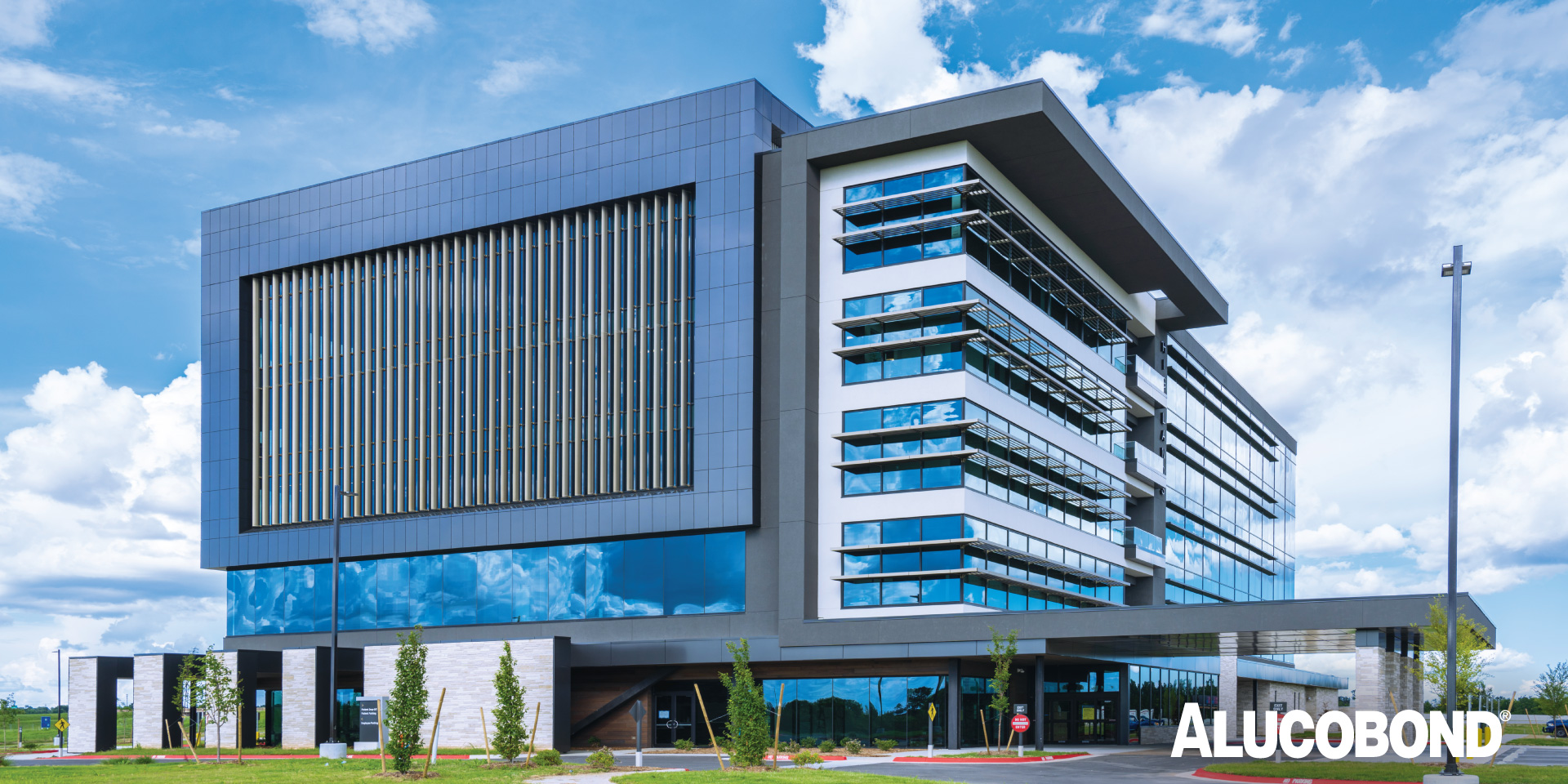
Project name: Highlands Oncology Location: Springdale, US Product: ALUCOBOND® PLUS 4mm Architect: Crafton Tull Building Owner: Highlands Oncology Group Fabricator/Installer: Ace Glass Construction Corp. Colour: Brushed Carbon Completed year: 2020 Photo Credit: Ace Glass Construction Corp.
With increasingly stringent operational energy regulations, building facades have transformed from mere aesthetic elements into critical environmental performance components. Among passive design approaches, solar control stands as the most significant factor in minimising internal heat gains, especially in regions with high solar irradiance. When combined with strategic orientation and thermally optimised envelopes, effective shading reduces cooling energy requirements while improving comfort levels.
This article examines how modern facade engineering utilises solar control, strategic orientation and intelligent material selection to deliver significant performance improvements. It also presents the ALUCOBOND® Solar Shading Software Service, a computational tool that enables precise, climate-adapted facade design.
Solar Shading: A Fundamental Passive Approach to Energy Optimisation
Direct solar radiation represents one of the major contributors to thermal loads on glazed building exteriors. Intercepting this radiation before it penetrates the building envelope offers the most efficient method to minimise mechanical cooling demands.
Facade engineers and architects employ shading fins, perforated screening, overhangs and integrated shading assemblies to reduce incident solar radiation while preserving visual connectivity and adequate daylight levels. Properly designed shading systems lower cooling energy use, optimise natural light entry, reduce glare intensity, maintain stable interior temperatures and minimise HVAC operational cycles.
Effective shading forms the cornerstone of performance-oriented facade strategies across commercial developments, educational facilities and residential buildings.
Orientation: The Cornerstone of Climate-Responsive Facade Engineering
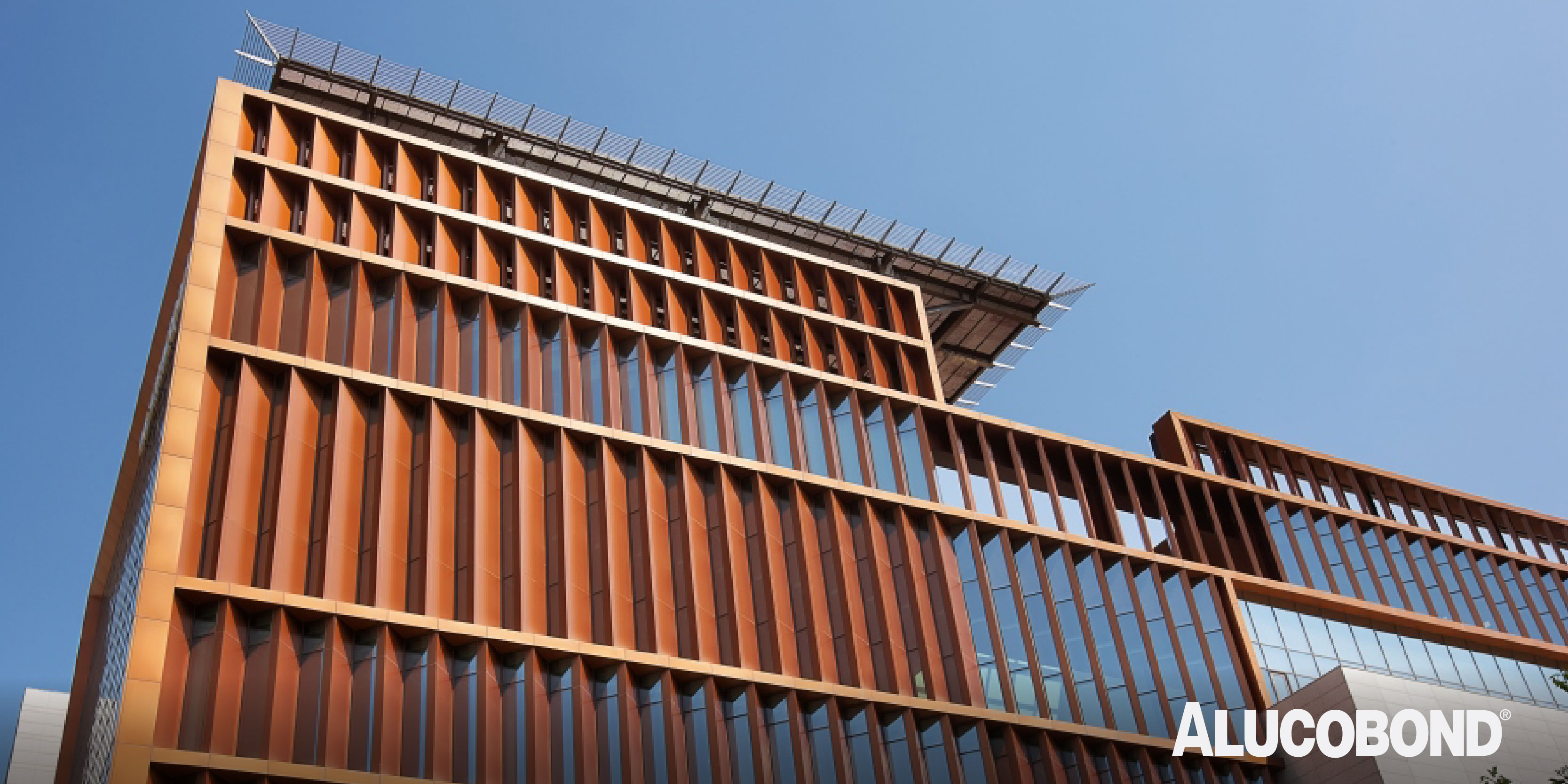
Project name: LG Science Park | Location: Seoul, South Korea | Product: ALUCOBOND® PLUS 4mm | Architect: GanSam Architect | Fabricator/Installer: LG Housys, DaeLim Industry | Colour: naturAL Copper 434 | Completed year: 2017 | Photo Credit: Studio MP
Building orientation dictates the intensity, angle and timing of solar exposure, establishing the foundation for any effective shading approach.
- East-facing facades demand shading solutions for low-angle morning sunlight.
- West-facing facades require deeper or more densely positioned fins to address prolonged afternoon solar heat.
- South-facing facades in tropical climates benefit from extended horizontal shading elements.
- North-facing facades typically need limited shading but may require controlled daylight strategies.
Initial design simulations inform glazing percentages, facade recesses, shading element projections and supporting structure load requirements. Architects increasingly utilise solar analysis tools during early design phases to assess the viability of diverse facade design ideas and ensure alignment with sustainability objectives.
High-Performance Envelope Systems: Maximising Thermal Efficiency
Shading alone cannot achieve optimal results without integration with a thermally efficient building envelope. Aluminium composite materials including ALUCOBOND®, ALUCORE® ACCP & Honeycomb and ALUCODUAL® deliver the rigidity, precision and longevity essential for both cladding and shading applications.
Key advantages include:
- Lightweight assembly, minimising structural loads
- Resistance to thermal distortion and weather-related deterioration
- Exceptional surface flatness for accurate facade installation
- Consistent performance across varying climate zones
These properties make them appropriate not only for new construction but also for facade design ideas in renovation projects where weight limitations, accessibility and installation constraints are important factors.
Engineered Material Systems for Effective Solar Shading
ALUCOBOND® provides a complete range of engineered materials configurable into high-performance solar shading assemblies. These encompass ALUCOBOND® PLUS (Fire Retardant Variant), ALUCOBOND® A2 (Non-combustible Core), ALUCORE® ACCP & Honeycomb and ALUCODUAL®, each designed to provide the structural integrity and environmental durability necessary for demanding facade applications.
These material platforms deliver
- High rigidity-to-weight performance, crucial for projecting fins and extended shading components
- Outstanding weather and UV durability, vital for elements under constant solar exposure
- Dimensional stability, ensuring shading fins and screens retain accuracy throughout their service life
- Design versatility, accommodating diverse shading configurations commonly found in contemporary building facade design ideas
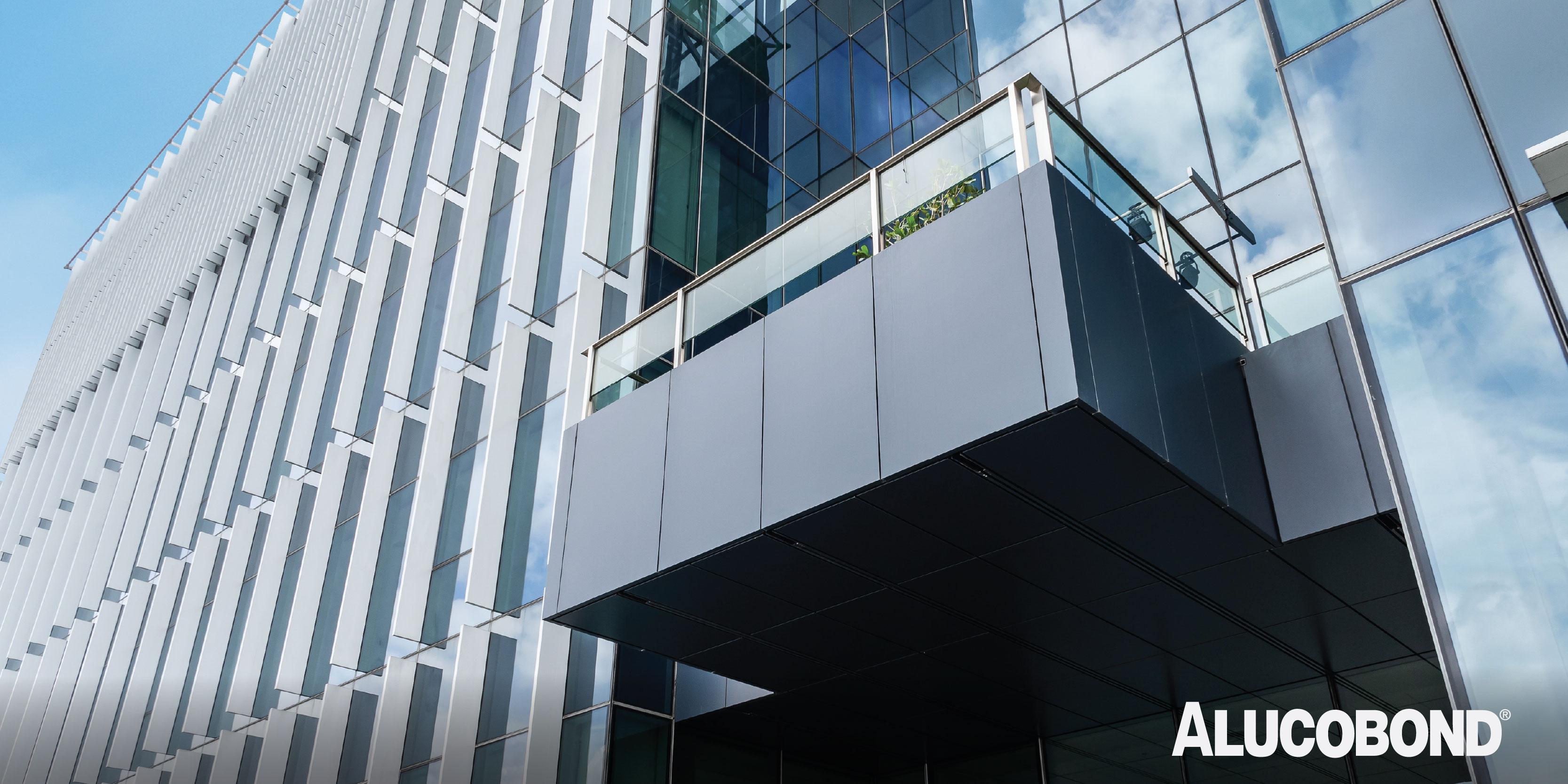
Project name: AIA East Gateways | Location: Bangkok, Thailand | Product: ALUCOBOND® PLUS 4mm | Architect: Creative Crews Co., Ltd. | Fabricator/Installer: Peterson 1990 Co., Ltd. | Colour: Custom Colour - Dark Grey Silver Metallic 4135 | Completed year: 2023 | Photo Credit: © 3A Composites Asia Pacific Pte. Ltd.
Their structural strength combined with minimal weight makes them well-suited for vertical louver systems, horizontal canopies, perforated screens and sophisticated parametric shading configurations utilised in high-performance facades.
Surface Finishes, Coating Technologies and Design Flexibility
To satisfy both environmental performance and aesthetic criteria, 3A Composites materials feature an elaborate selection of finishes:
- Metallic
- Solid architectural colours
- Natural stone aesthetics
- Wood textures
- Anodized-look surfaces
- Glossy muted tones of pastels
All materials include high-performance PVDF/FEVE Coil Coating systems, complying with AAMA 2605 (American Architectural Manufacturing Association) performance standards and ECCA (European Coil Coating Association) specifications. These coating systems provide:
- superior UV resistance
- extended colour retention
- chemical resistance
- minimal maintenance demands
This extensive finish range allows architects to incorporate shading elements harmoniously into the envelope, whether the architectural expression follows minimalist principles, parametric design or biophilic facade design concepts.
ALUCOBOND® Solar Shading Software Service: Engineering Precision Through Simulation
To facilitate evidence-based design decisions, ALUCOBOND® provides a specialised Solar Shading Software Service delivering project-specific optimisation.
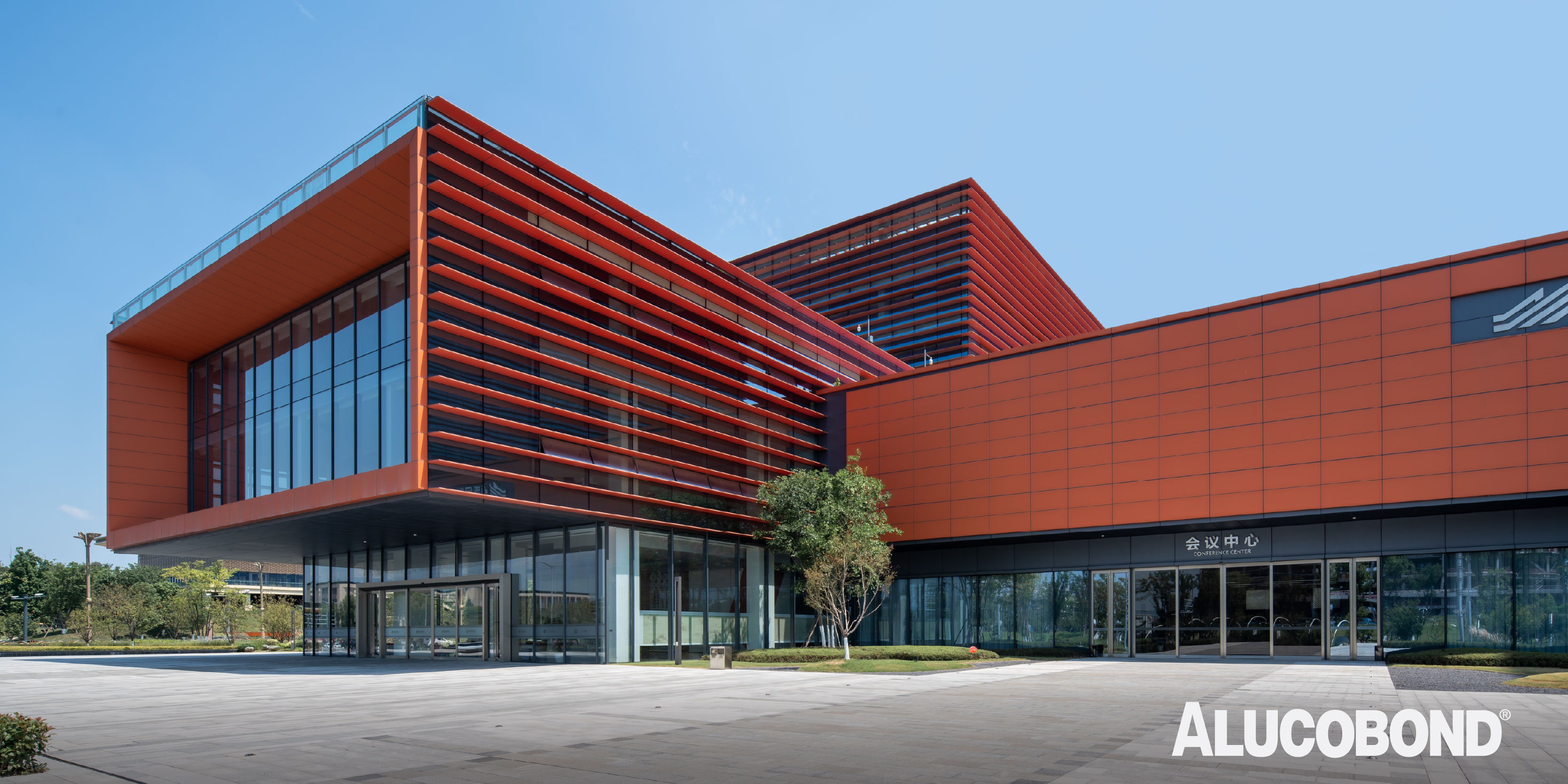
Project name: Western Financial Innovation Center | Location: Chengdu, China | Product: ALUCOBOND® PLUS 4mm | Architect: Ateliers 2/3/4/ & CDAD | Colour: Terra Brick Red 8391 | Completed year: 2021
Through this service, ALUCOBOND® engineers and optimises complete solar shading solutions for individual projects. The methodology incorporates comprehensive sun-path analysis for each facade orientation, ensuring shading is calibrated precisely to site-specific climatic conditions and building geometry. The result is a tailored shading strategy delivering effective solar protection while preserving unobstructed exterior views.
Following the solar analysis, ALUCOBOND® delivers engineered guidance on:
- Implementing vertical or horizontal fin systems
- selecting fixed or adjustable fin arrangements based on performance requirements
- determining fin specifications, including depth, spacing and projection, to balance daylight and structural wind loads
- specifying the optimal material system for each application including ALUCOBOND®, ALUCORE® ACCP & Honeycomb or ALUCODUAL® defining the suitable attachment methodology and substructure integration for sustained stability
Implementing Shading Across Diverse Building Types
From commercial towers to institutional and residential architecture, performance-based shading has become industry standard practice. Typical applications feature:
- extended horizontal projections on south-oriented facades
- tightly spaced vertical fins for west-facing elevations
- perforated aluminium screening for controlled diffused lighting
- lightweight honeycomb fins for wide-span shading applications
- parametric shading configurations based on climate modelling
These strategies elevate both the performance and aesthetic quality of modern exterior facade design ideas while achieving progressively ambitious environmental targets.
Conclusion
Energy-efficient facade design relies on the integration of shading geometry, building orientation and envelope optimisation. As the architectural profession pursues reduced operational energy consumption, solar shading emerges as the most justified design strategy.
The ALUCOBOND® Solar Shading Software Service reinforces this methodology by delivering precise strong support, enabling architects and facade engineers to develop shading systems that harmonise efficiency, durability and architectural expression.
Utilising high-performance materials such as ALUCOBOND®, ALUCORE® ACCP & Honeycomb or ALUCODUAL® combined with an array of advanced surface finishes, designers can realise facades that satisfy both technical performance standards and the advancing visual language of contemporary architecture.
Ready to Transform Your Vision into Reality?
Explore the boundless potential of ALUCOBOND®, ALUCODUAL® and Connect with our team at alucobond.india@3acomposites.com to get started.